
March 05, 2026

Written by:
Greg Schubert
Bruxism and chronic clenching are some of the most common disorders when it comes to dentistry. On the bright side, there are plenty of solutions out there, including night guards. However, the effectiveness of that appliance depends heavily on the night guard materials selected for the case.
Knowing what types of night guards are available and how each dental night guard material performs lets you improve your patient’s comfort, increase compliance, and extend appliance longevity. Whether it’s a soft EVA guard, a rigid acrylic guard, or a dual-laminate system, each material serves a distinct purpose.
Our guide breaks down the top custom dental night guard materials, when to use them, and how to select the best material for your practice's night guard cases.
All of your patients generate vastly different levels of occlusal force. A mild nighttime clencher requires a different appliance than a severe grinder with extensive enamel loss.
If your patient doesn’t have the right material for their night guard, it can cause:
Overall, the materials used for night guards impact both you and your patient. For your patient, the material affects the night guard’s durability and how comfortable it feels. For you, choosing the right material means spending less time having to adjust the material after the fact, especially if you work with a dental lab like PRO-Craft. Understanding the pros and cons of these bruxism night guard types helps us work together to craft a night guard that meets your patient’s needs.

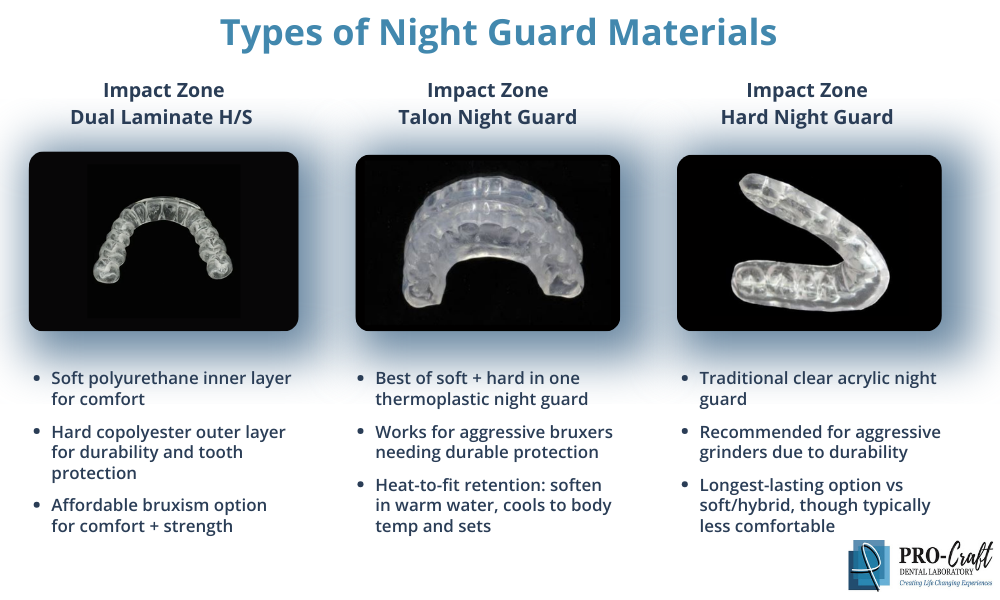
Soft night guards are typically fabricated from ethylene-vinyl acetate (EVA), a flexible thermoplastic material widely used in dental appliances. These types of night guards are usually vacuum-formed over a model of your patient’s teeth for a more accurate restoration.
An EVA night guard is best for:
They are best for cases where you might be evaluating a night guard for clenching vs. grinding, specifically if it’s a milder case.
When comparing a soft night guard vs. a hard night guard, soft appliances prioritize comfort but sacrifice long-term durability.
Soft guards can also serve as a transitional appliance before upgrading to a more durable material.
Hard night guards are typically fabricated from rigid acrylic resin, often heat-cured polymethyl methacrylate (PMMA). These are considered one of the most durable dental lab night guards available.
A hard acrylic night guard works best for:
For patients with significant occlusal wear or TMJ disorders, a hard acrylic night guard offers strength and structural stability.
While less comfortable at first, hard guards remain one of the most effective long-term solutions for high-force bruxers. For more information about lab-fabricated options, explore PRO-Craft's Night Guards and custom cases.
A dual laminate night guard combines two materials: a soft inner layer (usually EVA) and a rigid acrylic outer shell. This hybrid night guard design delivers the best of both worlds: as comfortable as a soft night guard, yet as durable as a hard type.
The best use cases of a dual laminate night guard are for:
They are particularly helpful in cases where you may need to decide between a soft night guard vs. a hard night guard, and your patient ends up falling somewhere in the middle.
Dual laminate night guards are often the preferred option when upgrading from a soft appliance that shows premature wear.
A thermoformed night guard is fabricated using vacuum- or pressure-forming techniques over a dental model, which is then trimmed and polished. This common method in dental laboratories can involve either single-layer EVA or multilayer laminates, including dual laminates.
Thermoforming is a common technique used in producing many dental lab night guards, especially soft and dual-laminate designs.
When evaluating the types of night guards, consider the following clinical matrix:
For the most part, there is no universal “best” option, as the best material for night guard cases is really going to depend on your patient.
Not all bruxism presents the same way. Determining whether a patient primarily clenches or grinds influences material selection.
Teeth grinding is a more dynamic movement that increases the risk of enamel wear and other tooth damage. Clenching is a more static contact between the teeth and won’t lead to as much wear and tear. Instead, it will lead to more soreness and damage to the jaw muscles and joints.
In many grinding or clenching cases, a hard or dual-laminate appliance will outperform soft EVA, which can wear quickly under significant force and pressure.
Selecting the appropriate custom dental night guard materials requires evaluating:
Educating patients on the rationale behind material choice improves compliance and reduces remakes.
Night guards remain one of the most commonly prescribed protective appliances in dentistry, but there is no single “best” type. The best material for night guard cases depends on occlusal force, TMJ involvement, patient compliance, and long-term goals.
Another important part of the process is working with a reliable dental lab partner, such as PRO-Craft Dental Labs.
At PRO-Craft, we offer:
Collaborating with an experienced lab means your patient receives the dental night guard material that best matches their needs. If you want your patients to get the best-of-the-best in night guards, contact PRO-Craft today to learn how we can help you help them.
If you’re new to PRO-Craft (or want a smoother process for night guards and other restorations), request our Free Dental Practice Starter Kit. It’s a quick way to get the essentials you need to start sending cases confidently, streamline collaboration with your personal technician, and unlock ongoing savings each year as you continue working with PRO-Craft for high-quality restorations made in the United States.

At PRO-Craft Dental Laboratory we've worked with a variety of dental impression materials over the past 40 years we have been in business. Based on our experience, there are a few brands we recommend...
Read More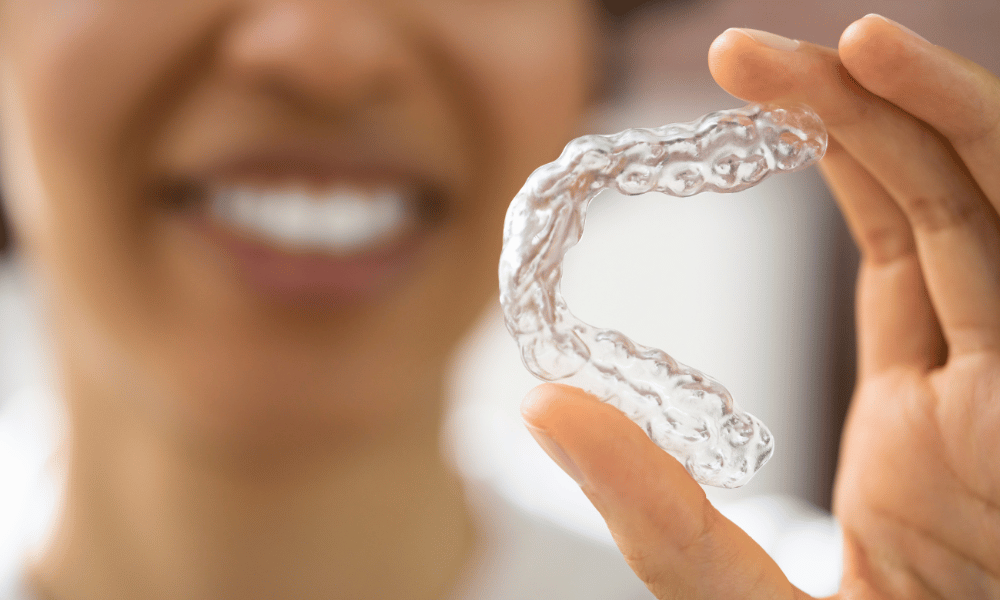
Night guards are invaluable dental devices that protect your teeth and jaws from harm through nighttime teeth grinding and clenching, known as bruxism. Night guards come in various styles, tailored...
Read More
Multi-unit abutments offer a versatile and efficient solution for complex restorative cases involving multiple dental implants. These specialized components are crucial in implant restoration...
Read More
As an industry leader in CAD/CAM technology, we have taken the fabrication of digital restorations to a new & exciting level of service.
25791 Jefferson Ave, Murrieta, CA 92562
info@pro-craft.com
877-484-3522